


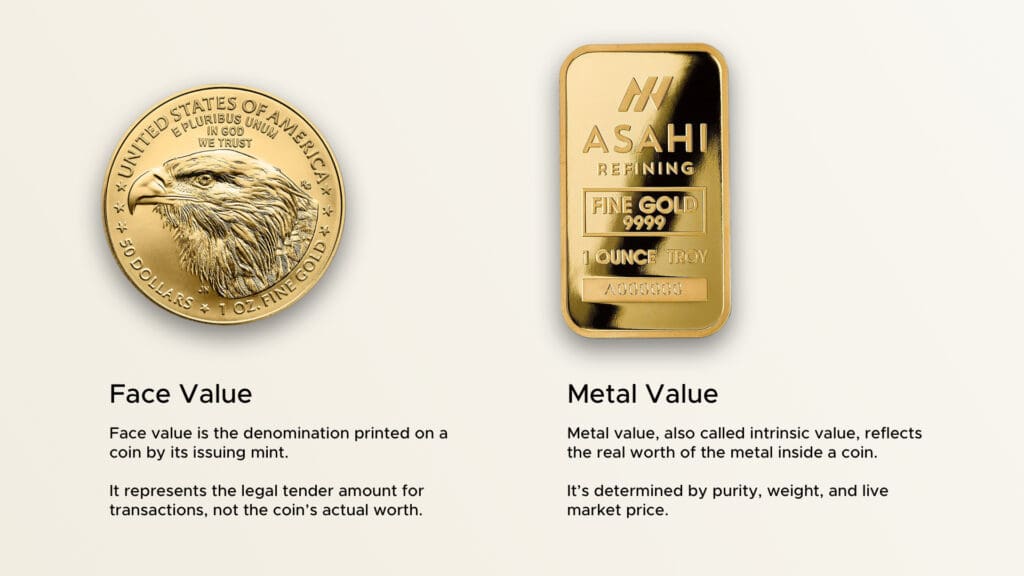
Face value and metal value are often misunderstood by new collectors. The face value is what appears on the coin such as one dollar or fifty cents. The metal value, often called intrinsic value, comes from the actual amount of gold, silver, platinum, or other precious metal inside the coin.
This is why a coin like the fifty dollar American Gold Eagle trades for well over two thousand dollars even though its denomination says fifty. Knowing the difference helps collectors appreciate what truly defines a coin’s worth which includes its metal content, history, and craftsmanship.
If you have already explored Learn Gold Premiums Explained this is the perfect next step.
What Does Face Value Mean
The face value of a coin is its official legal tender denomination set by the mint that issues it. It represents the amount the coin could theoretically be spent for, though in practice no collector would hand over a gold Maple Leaf for groceries.
For example
- The one ounce American Gold Eagle carries a face value of fifty dollars
- The one ounce Canadian Silver Maple Leaf carries a face value of five Canadian dollars
The true worth of both is based on the precious metal within, not the number stamped on the surface. Face value mainly serves as a mark of authenticity and government backing.
What Defines Metal Value
Metal value or intrinsic value depends on three key factors
- Metal content: the purity of the gold, silver, platinum, or palladium
- Weight: measured in troy ounces
- Spot price: the live market value of the metal
Formula:
Metal Value = Metal Content × Weight × Spot Price
If gold trades at 2400 dollars per ounce, a one ounce coin with .9167 fine gold such as the American Gold Eagle contains about 2200 dollars in gold.
This number represents the coin’s real value apart from collectibility or artistry.
Real Examples of Face Value and Metal Value
| Coin | Face Value | Metal | Approx Metal Value | Why It Matters |
|---|---|---|---|---|
| One ounce American Gold Eagle | 50 USD | Gold (.9167 fine) | Spot | U.S. legal tender but valued for its gold |
| One ounce Canadian Silver Maple Leaf | 5 CAD | Silver (.9999 fine) | $30 | Recognized worldwide for its purity |
| One ounce Platinum Philharmonic | 100 EUR | Platinum (.9995 fine) | $1000 | European mint design and rarity |
| One ounce Silver Britannia | 2 GBP | Silver (.999 fine) | $30 | Iconic Royal Mint craftsmanship |
Although the face value gives each coin identity, it is the metal market that defines its true worth.
Why Metal Value Matters More to Collectors
Collectors often focus on the purity and authenticity of the metal rather than its legal tender value. This perspective connects them with the enduring history of precious metals which have held intrinsic worth long before modern paper currencies existed.
Recognizing the metal value helps collectors avoid overpaying for novelty coins and understand that a coin’s real strength lies in what it is made of rather than what is printed on it.
For a deeper perspective, read Why Gold Remains Valuable: The Timeless Story of Gold as Currency.
Coins to Explore from Coins Online
These coins currently available at Coins Online demonstrate the concept of face value versus metal value clearly
- One Ounce American Gold Eagle carries a fifty dollar face value yet trades for its gold content
- One Ounce Canadian Gold Maple Leaf holds a fifty Canadian dollar face value and is renowned for its .9999 fine purity
- One Ounce Silver Britannia features a two pound face value and stunning Royal Mint design
- One Ounce Platinum Philharmonic carries a one hundred euro denomination but is valued for its platinum content
Each reflects the lasting truth that real value lies in the metal, not the number.
Conclusion
Face value gives a coin its title while metal value gives it meaning. Whether holding a Gold Eagle or a Silver Maple Leaf, collectors understand that purity, weight, and artistry define the true essence of worth.
Continue your learning with the Beginner’s Guide to Precious Metals or browse our Gold Coins Collection to see this concept in practice.
Resources
- Learn Gold Premiums Explained
- Beginner’s Guide to Precious Metals
- Why Gold Remains Valuable
- Gold Coins Collection
- Silver Bullion Collection
The face value is the official denomination printed on a coin such as one dollar or two pounds which defines its legal tender amount.
Because gold has its own intrinsic worth determined by purity and weight, not by the number stamped on it.
Not usually. Collectors focus on design, condition, and metal purity rather than the denomination.
Multiply the coin’s weight by its metal purity and then by the current spot price of that metal.
Not all. Some bullion coins follow metal value only while others gain collectible appeal from rarity or artistry.
Leave a Reply